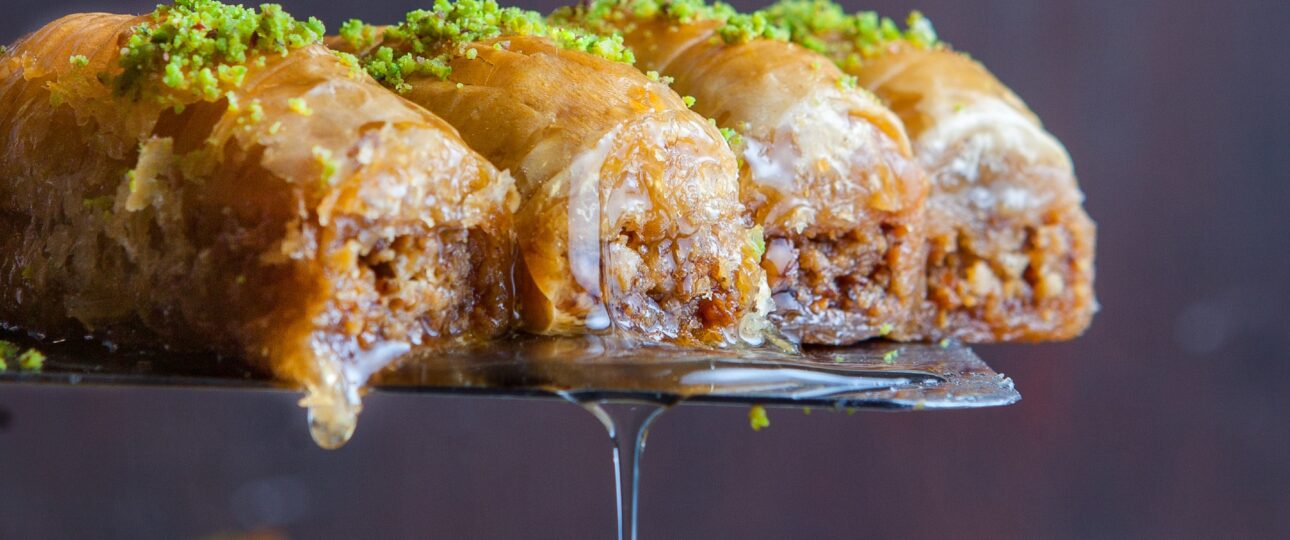
Baklava
Baklava; It is a dumpling that has a place in Turkish, Balkan, Middle Eastern and South Asian cuisines. It is made by putting walnuts, almonds, hazelnuts or pistachios, depending on the region where it is made, between the thin layers of phyllo. Usually sugar syrup is poured on it, but you can also add honey syrup if you want. Baklava was registered as a Turkish dessert by the EU Commission on 8 August 2013. A word of Turkish origin, “baklava” is referred to as “baklagu” or “baklagi” in Old Turkic. Another proof that this word is Turkish is that the origin of the word, which is used in the process of rolling out the baklava dough, is a word that has been used in the old language such as “oklağa” or “oklağu”, and is a word that is mentioned in written works before the 16th century. There are also those who say that the name “Baklava” derives from the Mongolian word “bayla-“, but this word also passed into Mongolian from Old Turkish. The Arabic word “bakla” has no connection with the Turkish word “baklava”.
History of Baklava
Baklava is found in the culinary culture of many nations and many nations try to own this dessert. Over time, it took its current form in Topkapı Palace. Today, there are some guesses about where baklava originated. The first is that baklava comes from the placenta cake in Roman cuisine. The second is the theory that baklava comes from the “layered bread” of the Central Asian Turks. Another theory claims that baklava comes from the Persian “lauizanaq” dish. Among these theories, we can say that the most similar to baklava is the placenta in Roman cuisine. This dessert was made by coating the baked dough with honey. Many sources claim that this dessert developed during the Byzantine period and turned into the current baklava. The most talented and successful masters of the Ottoman period were undoubtedly in the palace. At the beginning of the 18th century, a tradition called the baklava procession emerged. In the middle of Ramadan, as a compliment from the sultan to the soldier, baklava was taken from the Palace to the Janissary Corps. A sini (round tray) of baklava was prepared for every ten soldiers and lined up in front of the palace kitchen. The soldiers would take these trays and march towards the barracks. The people of Istanbul took to the streets to see this ceremony and greeted the soldiers. But when the Janissary Corps was abolished, this tradition also disappeared into history.

Types of Baklava
Gaziantep in Turkey is a city known for its baklava. In this city, pistachios are used in baklava. The material used in the baklava varies according to the regions. Pistachio is put in it in Southeast Anatolia, hazelnut is used in the Black Sea, almonds in the Aegean, sesame in Edirne and Thrace, and walnuts in Central Anatolia. Although the most popular one is made with Gaziantep pistachio, walnut, which is an economical alternative, is also preferred. Baklava can be served plain or with ice cream and cream. If the pastry of the baklava is thinly rolled and there are plenty of walnuts or pistachios in it, that baklava can be considered as high quality.
The capital of baklava is Gaziantep. This baklava is passed on from master to apprentice, that is, from generation to generation, and this is how it manages to preserve its flavor. The ingredients of this baklava also play an important role in its differentiation. In this baklava, flour made from hard wheat grown in the Harran Plain is used, and a rolling pin made of pear wood is used to roll the dough. Roll out 40 layers of dough thinner than paper. The unique pistachios of Antep and sherbet are added to these phyllo dough. The secret of good baklava is in quality ingredients. All products such as peanut, oil, flour, milk, sugar, starch play a decisive role in the quality of baklava. If the master knows his job well, that baklava will be good. You should hear the rustling sound it makes while biting the baklava. There are many varieties of baklava in various regions. Some of these are Antep baklava, Sivrihisar Muska baklava, Tavas baklava, Devrek white baklava, Erzurum molasses baklava, Tirilye baklava.


