Description

The history of the town BC It goes back to 2 thousand BC, this dating is associated with the underground city discovered in the middle of the city. Christians and Greeks lived together until the population exchange, the name of the city during the Ottoman period is also Enegüp. After Nevşehirli Damat İbrahim Pasha became the Ottoman Grand Vizier, Hacı Abdullah Ağa, one of the members of Kaymaklı town, entered the Ottoman palace as a head chef. Since Abdullah Ağa was directly in the palace bureaucracy, he pioneered in bringing drinking water to Kaymaklı and building a mosque in his name. Throughout history, it has made a living with agriculture, although the tourism vitality of the underground city can be seen today, since there are no different natural and historical tourism places outside the city of settlement, the people are generally engaged in agriculture, the largest planting products are potatoes, wheat, pumpkin seeds. As a result of the fact that the pumice stone discovered in the 1980s has a large number of regions and it can be converted into a usable product for the construction sector, the number of production facilities in this area has increased, contributing to the city’s economy and job rate.
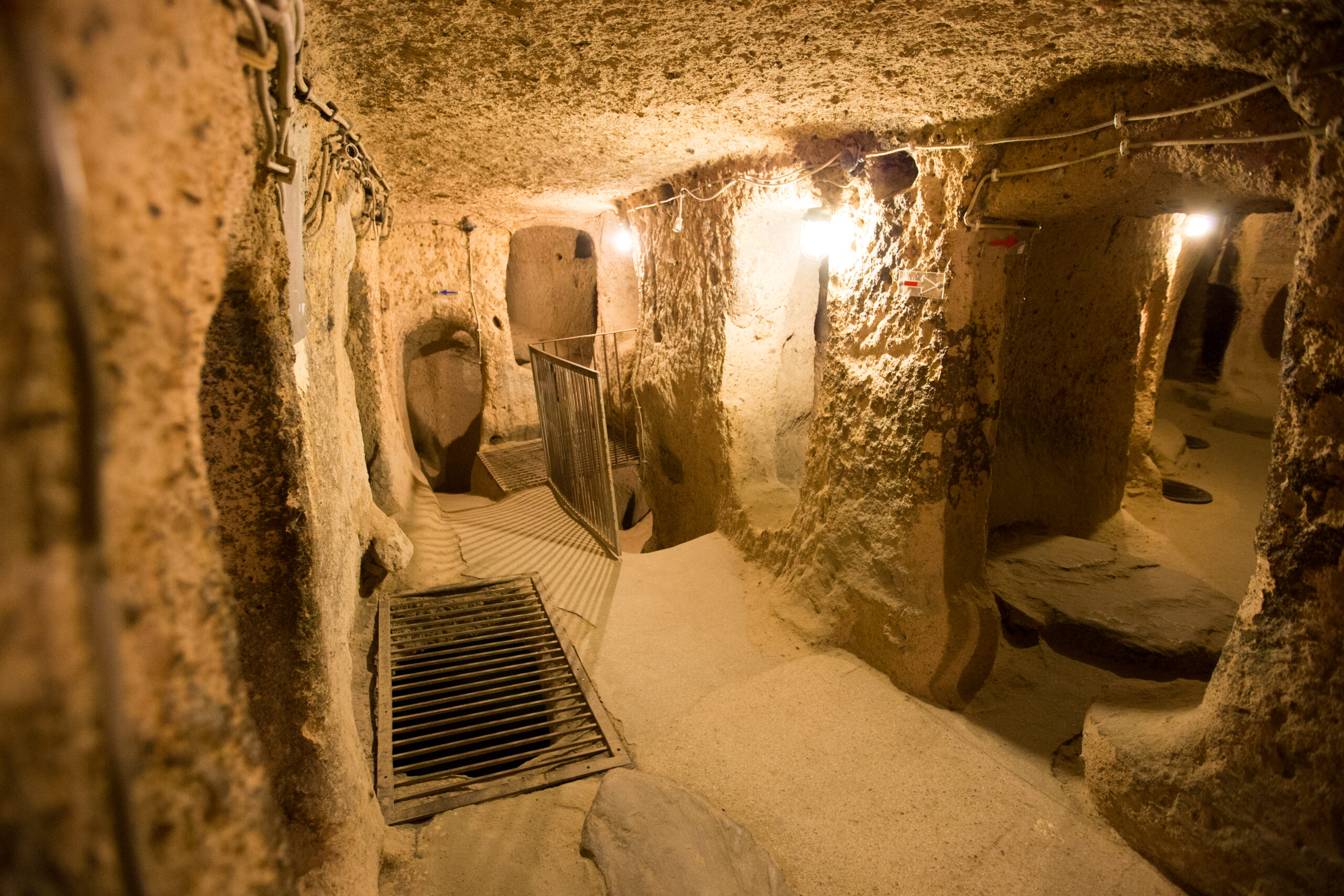
Kaymaklı Underground City: This underground city dating back to the Hittites period has been used for different purposes and by different civilizations for centuries. It was opened to visitors in 1964. It is thought that the actual size of the 4-storey section opened to visitors is only 8%, its real capacity is thought to be able to accommodate 15 thousand people. It contains storehouses, ventilation shafts, water wells, a church, tomb carvings and escape tunnels. There is a connection from some houses on the surface to the underground cities. Especially the Christians fleeing the Roman invasion migrated to Anatolia in the 2nd and 3rd centuries and settled in the Cappadocia region and built other layers of these underground cities. In this way, they were able to transfer their own culture to the future. It contains churches, warehouses, living rooms, a kitchen, a winery and many tunnels. Some of these tunnels are tunnels that connect underground cities and stretch for kilometers. There is a 9 km long tunnel connecting Derinkuyu and Kaymaklı. It has been the perfect escape route in times of danger. Generally, the tunnels are wide enough for only one person to pass. In the face of a possible attack, it aims to prevent the enemy soldiers from entering these underground cities en masse, to restrict their movements and to neutralize them more easily. In addition, the safety of these tunnels is ensured by the sliding doors that you can see frequently. But underground cities are simply built. Decorations such as painting decorations were not used. that these underground cities were only used for a short time until the danger passed. It was used as a shelter, not a living space. Of course, in other periods, these underground cities were also used as cold storage. As it is known, the rock formations in the Cappadocia region are able to keep the same temperature in summer and winter months.

Gallery

Explore Tours

Popular Cappadocia
Cappadocia
2 days
0 /5
$80.00
More Information
Fascinating Cappadocia Tour
Cappadocia
1 days
4
  • Location4
  • Amenities4
  • Services4
  • Price4
  • Rooms4
4 /5
$110.00
More Information

Login