Mausoleum
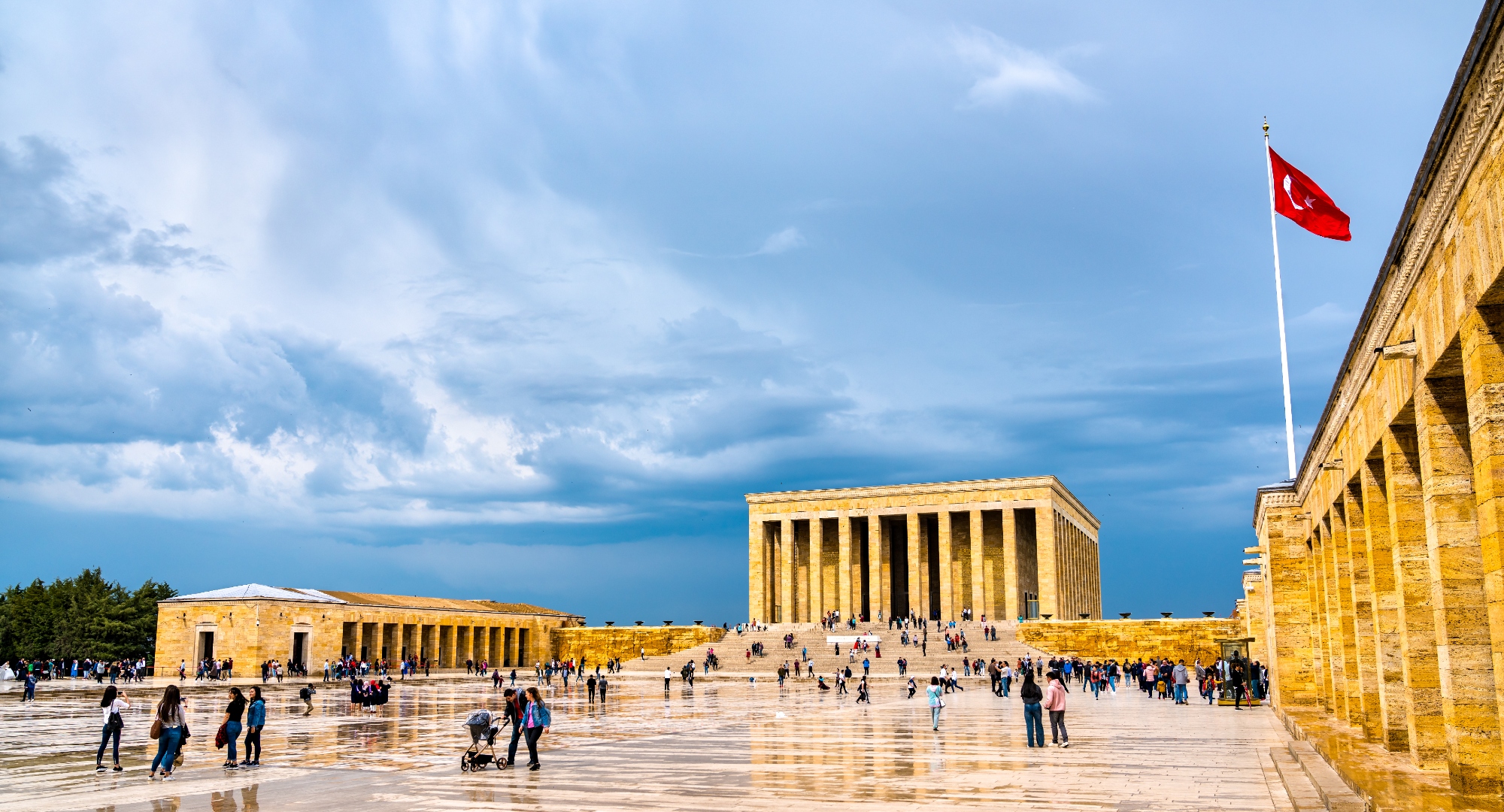
Anıtkabir, one of the most important places in the history of Turkey, is the place where Mustafa Kemal attained eternal life. Anıtkabir, which has been visited by many people over the years, has always been one of the key points for Turkish history. Anıtkabir is the tomb of Mustafa Kemal, who led our country during the Turkish War of Independence. While the Anıtkabir was being built, the most important thing was to design it in accordance with the personality of Mustafa Kemal Atatürk. In addition to İsmet İnönü, there are also the graves of Cemal Gürsel and 27 May Martyrs around Anıtkabir. Entry and exit to Anıtkabir is free of charge. Anıtkabir is open to visitors from nine o’clock to five o’clock in the evening. Thousands of people from all over Turkey still commemorate Atatürk and regularly visit Anıtkabir.
Date
Mustafa Kemal Atatürk is the jugular vein of the Turkish people with his great leadership in the War of Independence and liberation of the Turkish people. Mustafa Kemal Atatürk, who reintegrated and raised Turkey, passed away at the age of 57. The mausoleum was built with a splendor befitting him, reflecting Atatürk’s leadership and importance. He used to find an observatory on the site of Anıtkabir. That’s why it’s called Rasattepe. There were also tumuli belonging to the Phrygian state on this hill. After the decision to build Anıtkabir here, the tumuli were removed by archaeological excavations and taken to the Anatolian Civilizations Museum. Before the construction of Anıtkabir, first expropriation works were carried out. Construction began on October 9, 1944. The construction was completed in 4 stages in 9 years. Before Rasattepe, the planned places of Anıtkabir were Çankaya, Ethnography Museum, Karatepe behind the Turkish Grand National Assembly, Ankara Castle, Youth Park and Gazi Forest Farm. It was decided upon the proposal of Aydın Deputy Mitaht Aydın to the Turkish Grand National Assembly about Rasattepe. It is visible in Ankara Castle from the location of Anıtkabir. The night lighting of Anıtkabir and its wide view of almost all of Ankara also adds to its meaning. Anıtkabir, which exhibits a stance befitting Mustafa Kemal Atatürk in its night view, almost represents Turkey’s beating heart for Mustafa Kemal. For this reason, it stands out as one of the most special structures for all of Turkey. Everyone who comes to Ankara first visits Anıtkabir. In order to get to know and understand Atatürk and Turkish history closely, it is important to have knowledge and to visit other Ankara museums as well as Anıtkabir. Ankara Ethnography Museum is a museum where Atatürk’s body used to be. Although it was moved from there to prepare a suitable tomb for Mustafa Kemal, many belongings of Atatürk are exhibited there. In Anıtkabir, previously the fourth President, Cemal Gürsel, was buried in the martyrs’ cemetery in 1966. However, the former president’s grave was moved on August 27, 1988. İsmet İnönü was buried in Anıtkabir in 1973. The tomb of İsmet İnönü is still in Anıtkabir.
Architectural
The period when Anıtkabir was built is between 1940 and 1950 in Turkish architecture. This period II. It is called the National Architecture Period. In the period, cut stones with monumental aspects, suitable for symmetry, and sharp lines are revealed. In Anıtkabir, the architecture and period decorations used in the Seljuk and Ottoman periods are given a lot of space. Anıtkabir is located on an area of approximately 750,000 square meters. It is divided into two parts as Peace Park and Ant block. Anıtkabir’s architecture and design includes many details. Materials and period details belonging to many old Turkish states were used in Anıtkabir. All of these are located in Anırkabir, even a little bit, and represent the richness of Turkish history. As a mausoleum, Anıtkabir stands out as one of the largest and most important examples in history. Tourists, history lovers and Turkish people from all over the world visit both the rich historical building and the magnificent architecture. Sections of the Anıtkabir In the Peace Park, there are saplings from foreign countries and from Turkey. There are 104 different kinds of trees in the park. There are 48,500 plants available in the park. These plants not only make the area green, but also tell everyone about the value Atatürk gave to nature. These trees are regularly maintained every year and efforts are made to protect their nature and prevent any damage. The Monument Block contains three main sections. These sections include the Lion Road, the Ceremonial Square, and the Mausoleum. At the beginning of the Lion Road, there is the Independence Tower. Atatürk’s words are found on the walls of the tower. The Hürriyet Tower, on the other hand, tells about independence and has Atatürk’s words on it. There is also a group of female and male sculptures around this tower. Aslanlı Yolu is 262 meters long. There are also lion figures on the sides. In total there are 24 figures on the sides. There is a ceremonial square at the end of the Lion Road. The square has a capacity of 15,000 people. On the right of the Lion Road, there is the Mehmetçik Tower. Soldiers leaving their homes are represented on the reliefs on the tower. On the other side of the walls are Atatürk’s words with the soldiers. There are resources about the national struggle and Atatürk’s reforms in the Atatürk and Turkish Revolution Library. There is a gun carriage carrying Atatürk’s body in the Victory Tower. İsmet İnönü sarcophagus is a symbolic tomb. The actual tomb is located on the lower floor. İsmet İnönü was buried in Anıtkabir on December 28, 1973. Atatürk’s words “Peace at Home, Peace in the World” are on the inside of the Peace Tower. In this part, which is in relief, the farmers and a soldier protecting them are also depicted. Soldiers symbolize the Turkish army in this relief. Turkish people continue their daily lives with the trust they have in Turkish soldiers. Inside the Peace Tower are the Lincoln cars that Atatürk used between 1935 and 1938. On the wall of the 23 April Tower, there are reliefs showing the opening of the Turkish Grand National Assembly. Inside the tower is the Cadillac car that Atatürk personally used between 1936 and 1938. There is a flagpole in the middle of the stairs that reach the ceremonial square of Anıtkabir. The glorious Turkish flag is waving here. This mast is known as the highest of the single-piece flagpoles in Europe. It was built directly by Nazmi Cemal, a Turkish citizen living in America, and was gifted to Anıtkabir in 1946. The torch in the reliefs on the stone where the pole is located shows Turkish civilization, the sword power, the helmet defense, the oak branch shows victories in wars and the olive branch shows peace. Misak – I Milli Tower is located at the entrance of the museum. It represents the homeland to be one body and not to be divided. There is a lectern in the tower for those who attended the ceremonies held in Anıtkabir to sign the book. In this section, there are also photographs of the ceremonies that took place in Anıtkabir. Anıtkabir Atatürk Museum was opened on 21 June 1960. In this museum, there are belongings of Atatürk and gifts given to him. In addition to the medals, there are items donated to the museum by spiritual children Afet İnan, Sabiha Gökçen and Rukiye Erkin. These women, who have an important place in Atatürk’s life, show everyone what a good person they are. Revolution Tower is the continuation of Anıtkabir Atatürk Museum. Atatürk’s daily and formal dresses are displayed here. On the relief in the tower, there is a torch that is about to go out. This torch represents the Ottoman Empire, whose collapse is imminent. The other, brighter torch, on the other hand, describes the rising Republic of Turkey and the reforms made by Atatürk. Also in this part, Prof. Dr. There is a wax statue of Atatürk made by Yılmaz Büyükerşen. The Republic Tower is located at the entrance of the Art Gallery. In this tower, Atatürk’s words about the republic and his photographs belonging to the congress times are exhibited. There is also a special library in the Art Gallery. In this library, there are books belonging to Atatürk. In oil paintings, statesmen visiting Atatürk and Atatürk are depicted. This shows how much importance Atatürk attached to art and artists, even after his death. There is a male figure on the Defense – i Law Tower. This figure is holding a sword. This symbolizes a soldier. The tree behind it represents the Turkish society. In addition to Atatürk’s words, there is also a model of the Military Academy in the tower. Reliefs about the Battle of Sakarya and the Battle of the Commander-in-Chief are also located in Anıtkabir. In these reliefs, the effort of the society for the war is told. On the relief of the Commander-in-Chief, Atatürk’s leadership and the magnificent power of the Turkish army are depicted. The Mausoleum is one of the most special areas of Anıtkabir. Before coming to the mausoleum, there is an oratory. On the facade of the mausoleum, there are words spoken by Atatürk in the tenth year of the Republic. To enter the Hall of Honor, you must choose the bronze doors. On the left side of the entrance, there is the condolence message of İsmet İnönü on Atatürk’s death, and on the right, Atatürk’s last message to the Turkish army. Opposite the entrance of the hall is Atatürk’s symbolic sarcophagus. Atatürk’s body is in the grave room. On the floor of the mausoleum, there is a body in a grave dug into the ground. There are rooms and belongings of Atatürk and his delegation in Alagöz Headquarters Museum. Among these rooms are the dressing room, the kitchen, the battle room, the rest room and the staff room. It is also possible to closely examine what happened at that time, living conditions and personal belongings in these rooms and feel as if you were living in that time.
Memories of the Process
What makes Anıtkabir valuable is the presence of Mustafa Kemal Atatürk, the founder of the Turkish Republic, in it. After Atatürk passed away, a mausoleum was wanted to be built. For this, the Republican People’s Party held a meeting on January 17, 1939 and determined the location of the mausoleum. After the burial place was determined, a project competition was organized on March 1, 1941. After a 1-year competition period, Emin Onat and Orhan Arda’s project was chosen, but some changes were made before it was implemented. The construction of Anıtkabir began on October 9, 1994, with the foundation laid. Construction takes place in 4 parts. The first part involved the arrangement of the soil and the construction of retaining walls. On June 6, 1951, the last steps of the construction were completed. The entire cost of the construction was announced as approximately 20 million. With the ceremony held on November 10, 1953, Atatürk’s body was buried in Anıtkabir. Anıtkabir, which is of great importance for Turkey, is still visited by many heads of state. On national holidays and special days, Anıtkabir welcomes thousands of people and reunites Atatürk with his fans. Anıtkabir has a long history. Every detail in it has been specially thought and designed. Sculptures or reliefs, structures were made by the most experts in their fields. Atatürk makes his fans feel the importance he gives to Turkish history. There were always many books in his library to move Turkey forward. Atatürk kept the books he read over the years and contributed to Turkish culture. These books are still in Anıtkabir. The placement of everything belonging to Atatürk in Anıtkabir was done with care during the arrangement stages. Every artifact, every outfit and every item has been carefully placed and presented to the visitors.